
Uncommon Birds on 3 Crabs Road, Dungeness, WA
Uncommon Birds on 3 Crabs Road, Dungeness, WA
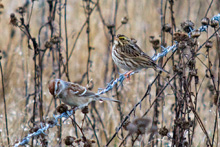
American Tree Sparrow
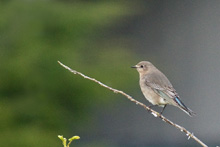
Mountain Bluebird
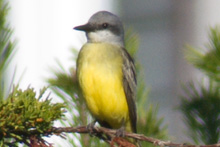
Tropical Kingbird
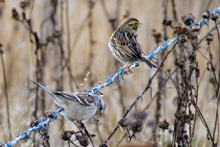
American Tree Sparrow
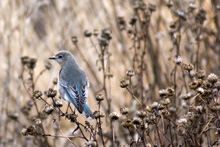
Mountain Bluebird
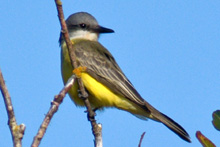
Tropical Kingbird
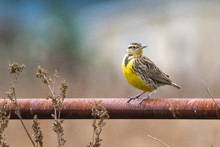
Western Meadowlark
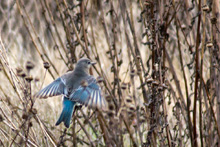
Mountain Bluebird
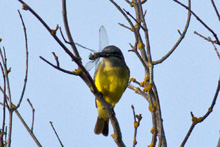
Tropical Kingbird
Bird of the Day
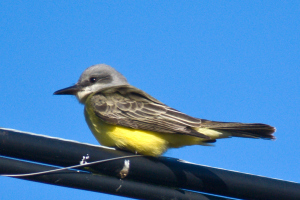
Tropical Kingbird (10/24/2011)
February 12, 2014
Do the same birds return to the same areas every year? Hard to tell without banding the birds.
October 24, 2011. On my way home from town I swung by Helen's Pond on 3 Crabs Road to see what is there, but the pond is bare. I did a u-turn and headed back. Out of the corner of my eye I noticed a bird perched on the power lines that seemed a bit odd-shaped. In the rearview mirror I saw a glint of yellow...unusual. Another u-turn and a closer look...Western Kingbird I thought! Code 4, rare and definitely worth a picture.
I took a few shots and went home where we looked closely at them and started thinking it looked more like a Tropical Kingbird...a Code 5 and a new bird for my life list! In fact, this bird is a Code 5 rarity in most of the country. It is widespread across Central and South America, but only a few ever make it north of the border into southern Texas and Arizona.
This was the first rare bird that I have been first to see and document. I let the local birders know where it was, and had to fill out a form with a detailed description and photos for the State Rare Birds Committee for them to acknowledge that it was here. I confess I was pretty excited. It became "my" bird, and I felt a bit of propietary pride in it as people showed up from all over the state to see it. It hung around for several weeks, then disappeared after strong winds in mid-November.
November 7, 2012. I again photographed a Tropical Kingbird in the same location. Was it the same bird? I thought I had scored a second "First," but when I reported the bird I learned that another birder had already reported it from a couple hours earlier. Dang! That year we had three of them here.
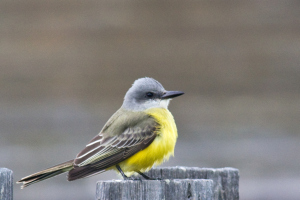
Tropical Kingbird (11/7/2012)
Fall, 2013. This year several of us started watching closely to see if one or more Tropical Kingbirds would return. On October 31, 2013 I got email from Liz, the woman whose yard I first photographed the bird in on October 24, 2011, and she had just photographed one in her yard. Same bird? Remember, this is still considered a Code 5 bird for Clallam County, although it is beginning to feel like a sure thing on 3 Crabs Road.

Tropical Kingbird (11/14/2013)
Although others reported finding this bird right away, it took me two weeks to find it. Everytime I went to where the last person spotted it, all I found was a Cooper's Hawk hanging out, and I guess the TRKI was hiding from it. This image shows why another name for this bird is bee-eater.
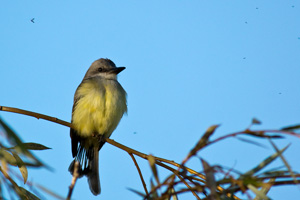
Tropical Kingbird (11/14/2013)
Look carefully at these last three images and you will see that this bird has a definite issue going on with its tail feathers. But it can still fly and feed. What happened, I wonder? We suspect the Cooper's Hawk had been molesting it, but this bird got away, and did manage to re-grow the feathers before it disappeared again. The lost tail feathers didn't seem to prevent the bird from flying and catching insects.
A second Tropical Kingbird, with all its tail feathers, was also photographed at this time so we had two here in 2013.
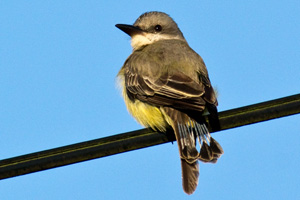
Tropical Kingbird (11/14/2013)
Having Tropical Kingbirds show up on 3 Crabs Road three years in a row, plus an additional sighting on 10/20/2013 at Neah Bay, cost this bird its Code 5 status. It is now a Code 4 bird for Clallam County. Should we expect to see more of these birds making their way north from the tropics each fall? Where do they go after spending 2-3 weeks here, back south? I'll definitely be looking for them again in October.
Dow